Do you remember what drew you to the field of Equine Assisted Services when you first started down this path? Was it to help people? To help horses? Maybe Both?
If you are like me, you wanted to take your work to the next level – to take something that was working well (family therapy) and improve it by meeting outdoors, finding sensory regulation and movement, and building relationships with horses that were mutually beneficial.
Or maybe you are not like me, there wasn’t “work” you were already doing – it was the horses themselves who drew you in, maybe even gave you refuge, safety, a place to belong.
Whatever your reasons for beginning to consider Equine Assisted Services, now you are here at Natural Lifemanship, and if you are like many of our students you may be wondering how much training you need, wondering how far you should go?
And then the big question, do you have to get certified?
The quick and simple answer is “No” you do not have to get certified. The field of EAS is still fairly new and fairly unregulated – you do not have to be certified in order to partner horses with humans in a way that could promote healing.
Another quick answer is “Yes” you have to be certified, or moving through a certification process, if you want to be covered by insurance.
But, should you get certified? We emphatically say “YES” – and we’re happy to explain why.
Certification costs money, can be a lengthy process, and requires maintenance no matter where you go – we don’t enter into this long-term relationship with you lightly. Your learning and development and your care of your community are at the forefront of our thinking as well. We have created our certification process and maintenance requirements because it is our mission, our deeply held value, and our ethical responsibility to ensure you are offering the safest, most ethical, most effective services you can for the people we all serve.
We’re always coming back to that “why” – the people and horses we are trying to help.
Why Get Certified?
For most of us, the people who knock on our office (and barn) doors are some of the most at-risk, highly vulnerable people out there. Time and again we hear the story of the client who has “tried everything”, nothing has worked, and so finally they are willing to come to us and try this ‘weird’ thing called Equine Assisted ________ (insert therapy, coaching, learning, wellness, etc.). Most of our clients are people for whom the traditional system failed – their trauma, their challenges, their needs are just more complex than a traditional system can handle.
These clients enter into our professional realms, and in doing so, they are asking us, “Will you keep me safe? Can I trust you to have the experience needed to help me?”
Whether you are certified or not – your ethical obligation is to be able to answer “YES!”
Signing up for certification with Natural Lifemanship sets into motion a carefully planned learning experience and mentorship that is intended to help you feel informed, supported, and encouraged to grow into a capable, effective, and ethical practitioner.
But we aren’t the only ones who feel this way – insurance companies also need to know you are offering your best services – services that are ethical and safe. They will ask you if you are certified.
If you are in the process of certification they will need to know that you have done X number of hours of training, and that now you are moving through a process of consultation and mentorship with seasoned professionals, ensuring that your services are ethical and safe. And in the event a claim is filed, they likely will ask us about your certification status as well.
Not Just a Piece of Paper: Why is Certification a Process?
Certification can seem like it is about a piece of paper – but it is so much more than that.
With Natural Lifemanship, certification is a process, it is about learning and mentorship that is both personal and professional. It takes time to learn information and integrate it into the work that you do. It takes even more time if you are building a new scope of practice.
We intentionally require our steps of certification so that you have time to develop, grow, and practice applying what you have learned, while being supported and mentored along the way. What we teach – the neurobiology of trauma, the paradigm shift of horses as capable, autonomous partners, the “being” of healing relationships – cannot be learned in just a few days. It would be unethical of us to suggest otherwise.
Our certification process takes time because your development takes time. From trainings to individual consults to group consultations – we will walk alongside you as you internalize the art and science of healing relationships.
When you receive a certification from Natural Lifemanship, you know that you have been through an experience that has set in motion a powerful transformation for you, your horses, and your clients.
What you do after your initial certification matters just as much.
Image Source: Building Bridges Leadership
Maintaining Certification: Why Do You Need to Continue Your Education?
Have you ever heard of the “Forgetting Curve”? The Forgetting Curve is a concept that has arisen from research – it tells us that anything we learn quickly, we will forget quickly. Learning requires depth and meaning in order to take hold in our memories. The Forgetting Curve also tells us that anything we are not routinely reminding ourselves of, will also be forgotten over time.
Continuing education is the backbone of ethical practice. If we were to certify your learning and then never ask you to revisit that learning, or expand and deepen that learning – you would begin to forget, you would lose what you had gained. And then over time your work would suffer.
Here at Natural Lifemanship, we work hard to produce intentional and meaningful continuing education opportunities, this is one thing your certification and maintenance fees pay for. We are constantly trying to improve ourselves as an organization, and we are constantly working to support your continued growth and development as well. Consultation, webinars, video content, conferences…this is how you overcome the forgetting curve.
Certification is how you become ethical and experienced, maintaining certification is how you stay ethical and experienced.
Keeping up with your certification is also necessary to receive coverage from insurance should anything happen – insurance is how you protect yourself and your clients when doing this unique and sometimes unpredictable work.
Where Ethics and Liability Meet
Cassie* (not her real name) is a practitioner who did the work to get certified in Natural Lifemanship. However, over time, she felt maintaining her certification wasn’t justified, and let her certification lapse. She continued to meet with clients utilizing Equine Assisted Therapy operating under the premise that she was NL certified. Unfortunately, one day during a session a client sustained an injury (not entirely unusual when we are working with horses) and Cassie’s client filed a claim so she could pay for her hospital bills and rehabilitation.
Cassie’s insurance called us to ask questions about her certification, and we were forced to reveal that while Cassie was at one time NL certified, she did not maintain her certification with us. Because of this, Cassie’s insurance would not cover the claim. Both she and her client were left with great expense. You see, insurance companies also understand the importance of ongoing learning and the “forgetting curve”—which is why maintaining certification matters to them as well.
This is a sad story, but also a very real one. Working with horses, and involving ourselves in people’s most vulnerable aspects of their lives means a higher risk of liability. We are more at risk, and our clients are more at risk, when we allow ourselves to forget our learning, our ethical obligations, and our commitment to growth.
We Are Walking Alongside You
There are many sad stories like this. It is a good reminder of the power we step into when we offer to be a healing guide for someone else. It is necessary to remember the risk involved when we spend our time with horses, with trauma, and we choose to be an influence over someone else’s wellbeing.
We at Natural Lifemanship do not enter into this long-term relationship with you lightly. We, too, hold ourselves to a commitment of growth and ongoing development, of ethical considerations, as well as personal and professional reflection.
This is why the expense, this is why the time – so that you are not alone as you endeavor to care for your communities of humans and animals. We walk this path together.
Ready to Take the Next Step?
If you’ve been considering certification, or you’re already on the path, now is the time to take action. For a limited time, five of the six steps in the Natural Lifemanship certification process are on sale. This is a really good time to deepen your learning, expand your practice, and walk more confidently in your ethical commitment to clients and horses alike (while saving some money in the process!).
Check out the NL Certification Sale now and take the next step in your professional and personal development.
When we launched the Natural Lifemanship (NL) Certification Program in 2016, we asked ourselves two important questions:
What does it mean to be NL certified? And what exactly are we certifying?
Many of us had been studying the Neurosequential Model with Dr. Bruce Perry. In our discussions, we kept returning to something he emphasized repeatedly when speaking about certification. He was clear that his program was designed to provide people with the experiences they needed to learn and apply the Neurosequential Model. However, he also acknowledged that the degree to which someone became competent in using the model was beyond the scope of what his program could evaluate.
Dr. Perry stated plainly: his certification program certified experience, not competence.
That framing deeply resonated with us. From the very beginning, Natural Lifemanship has taken the same stance:
We certify experience. We do not certify competence.
Competence Is a Moving Target
When we invest in our growth and learning, of course we want to become competent. With competence comes effectiveness and also confidence. We feel more capable, we know what we are doing, we achieve good outcomes, and as a result, we find our work rewarding and enjoyable.
However, what it takes to be competent changes with time and context. Just as you can never stand in the same river twice, you can never be assured that the knowledge and skills you possess right now will be sufficient to effectively deal with a situation you encounter tomorrow or a year from now.
True competence requires continual growth. One has never entirely “arrived.”
That said, accomplishments along the way are important. They demonstrate the extent of one’s dedication and striving to continually learn and grow. They show that you are moving along a path.
And at NL, being on the path is more important than reaching the end of it.
Engagement Prevails Over Competence
As a model that is deeply geared toward development—personal development, professional development, and even neurodevelopment—we are not in the business of asking, “Are you competent?” or, “Can you do this or that?“
Those are binary distinctions: yes or no; can or cannot. But real growth is a long process, with ups and downs, successes and failures.
The one essential criterion for growth is ongoing engagement. So instead, we ask: Are you engaged?
Engagement can be measured by both how often you show up and how you show up. You cannot be engaged if you do not show up at all. And once you do show up, the quality of your presence determines what you gain from any experience.
It is the quantity and quality of your experiences that reflect your level of engagement.
Engaging in experiences over time is more meaningful to us than demonstrating competence at a single moment in time.
Milestones, Not Endpoints
While your learning and growth with NL will never end (at least we hope they don’t!), we would love to help you celebrate and share your milestones and achievements along the way. That is why we are now very pleased to offer digital credentials.
These new digital badges and certificates of completion are earned when you reach certain milestones in the certification journey:
When you complete the Fundamentals of NL, you are considered Level 1 Trained.
When you complete the NL Intensive, you are considered Level 2 Trained.
The more experiences you engage in with us, the more badges you’ll earn. This is not intended to be a “token economy” or a system of rewards. Rather, it is a way to demonstrate a level of engagement and commitment.
Looking Ahead
We will be dedicating some future blogs to this subject as we aim to help EAS consumers better understand what to look for when choosing a practitioner.
These upcoming pieces will explore what our credentials actually represent, how they reflect experience and engagement, and why that matters when you’re seeking care rooted in connection and development.
We look forward to continuing the conversation, and we are honored to walk alongside you.
One of the hardest things about working in the field of equine-assisted services is answering this simple question: “What exactly do you do?”
What I do as a licensed mental health counselor can feel like a riddle sometimes. When I tell people I integrate horses into the counseling process, their minds often jump to a common image: therapeutic riding. While therapeutic riding programs are wonderful and do amazing work, what we offer in equine-assisted mental health services is quite different.
Our Unique Approach
Imagine a conversation:
Curious Person: “So, what exactly do you do?”
Me: “I’m a licensed mental health counselor, and sometimes I integrate horses into therapy. We work on the same goals you’d pursue in a traditional office setting, like managing anxiety, depression, ADHD, or PTSD. The big difference? Our ‘office’ is often outdoors, and we approach those goals in a unique way with horses.”
Curious Person: “Oh yeah! I think there’s a program like that down the road.”
(Usually, they’re referring to a therapeutic riding program for children with special needs.)
Me: “That’s a fantastic program, and I actually spent over ten years certified in therapeutic riding – I love it! But our work is distinct. Therapeutic riding is an adaptive sport, focusing on riding skills and physical benefits. Our work, on the other hand, is about mental health and personal growth. About 80% of what we do happens on the ground, and our goals are never about riding or horsemanship skills—they’re rooted in mental health. They’re always about the client’s emotional well-being and relational patterns.”
It’s Not About Grooming (Mostly!) – It’s About Connection
Another common question surfaces quickly:
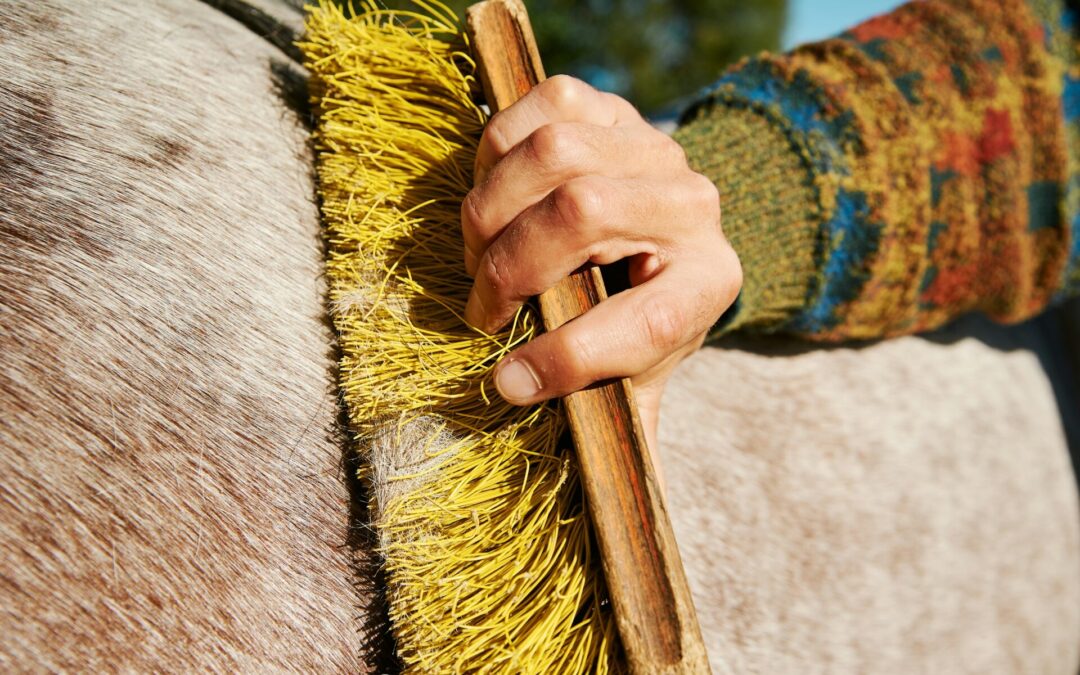
Curious Person: “So then what do you do with the horses? Just groom them?”
Me: “Sometimes grooming is part of it, but the core of our work revolves around the relationship between the horse and the person. We believe that true healing happens within the context of safe, connected relationships. The way that relationship is built with the horse is incredibly important.”
“We guide and support our clients as they learn to forge a deeply attuned relationship with a horse – one built on trust, consent, mutual respect, clear communication, appropriate boundaries, and genuine connection. These aren’t just feel-good words; they’re the foundational principles we practice every session.”
The ‘horse whisperer’ question almost always comes up, often with a slight giggle from my end.
Curious Person: “So, are you like a horse whisperer?”
Me: “Well, kinda. But I prefer to say it’s about horse listening. We learn to listen to the horse, and in doing so, we learn to listen more deeply to ourselves. Then, we learn how to respond intentionally and authentically to what we’ve heard.”
Now, as a professional in this field, I want to be clear: no self-respecting horse person claims to be a ‘horse whisperer.’ The term is Hollywood-glamorized and implies some secret, innate gift. However, I understand why the layperson uses it – it suggests a gentle, close, and seemingly magical communication with horses. And in that sense, it does get us closer to understanding what happens in our sessions.
You might observe a client asking a horse to follow them without a lead rope, simply through their body language and energy. You might see them walking in perfect sync or engaging in what looks like a beautiful dance as the client asks the horse to move away and then return. The communication is often subtle, nuanced, and incredibly gentle – so subtle, in fact, you might struggle to see it at all. Some might call this ‘horse whispering.’
Demystifying Attuned Relationships: The Heart of Our Mission
Here’s our core belief: Anyone can learn to communicate this way if they’re willing to do the personal work required. Attuned communication isn’t reserved for a gifted few. It’s learnable. It’s teachable. And most importantly—it transfers.
Our mission is to demystify attuned relationships, not just with horses, but with everyone. There are no hidden secrets—just sound relationship principles, practiced over time with support and intention. The profound lessons clients learn in building a respectful, consensual, and communicative relationship with a horse seamlessly transfer to all other relationships in their lives.
Horses are incredible partners. If we allow them, they will show us exactly how our internal and emotional states, and our resulting behaviors, affect others. With the right therapeutic support, they provide the perfect, safe space to practice new, healthier ways of being in relationship – with ourselves and with the people around us.
Ready to Go Deeper? Train and Certify with Natural Lifemanship
If something about this work speaks to you—if you’re drawn to the power of healing through relationship, connection, and the wisdom of horses—maybe it’s time to take the next step.
At Natural Lifemanship, we offer a clear and supported path to training and certification for professionals in mental health, education, coaching, and other helping and healing professions. Our approach integrates the neuroscience of relationships, the art of attunement, and grounded, trauma-informed principles to help you facilitate meaningful, lasting change for others—and for yourself.
Whether you’re just getting started or looking to deepen your current practice, certification with Natural Lifemanship offers:
A comprehensive, research-backed framework
Practical tools and embodied learning experiences
A vibrant, supportive community of like-minded professionals
Opportunities for personal growth and professional transformation
This isn’t just a training—it’s a way of being in the world. And we’re here to walk alongside you as you learn to build connection that heals.
There’s this popular saying that goes like this: Find what you love to do, and you’ll never work a day in your life. Do you know that one?
This phrase is inspiring and motivational, but it oversimplifies the reality of building and running a sustainable business. Yes, it’s so, so important to do work that lights you up. If you’re reading this blog post, it’s likely you’ve already found it. You know that working with clients and equine partners, in a natural setting, to facilitate healing is what you were called to do here on this earth. That part of the popular saying makes sense to most of us.
It’s the second part that’s a little tricky. I don’t know about you, but I absolutely love what I do, and it still feels like work every single day. In fact, I’d say I work even harder as a business owner doing what I love to do than I ever did when working for someone else.
Debunking the Myth
When I talk with people who stick it out in this field, no one claims that it doesn’t feel like work. People leave soul crushing corporate jobs or other roles that don’t fuel their passions in order to start a business offering Equine Assisted Services. Before they know it, they’re working harder than they ever did in that corporate job, but they wouldn’t have it any other way.
It’s like parenting. Parents say there is nothing that’s so exhausting as having a child—no job has ever been harder or more stressful, they’ve never had to worry about finances the way they do as a parent, they have sleepless nights and experience constant worry. And in the same breath they will say, “Oh, but I would never have it any other way.”
That goes for us in this business, too. It’s extremely hard, it creates stress and worry sometimes. It feels like work. But there’s nothing more mindblowingly worth it than this.
Work the Business, Don’t Let It Work You
The difference between people who succeed in this field and those who don’t make it is learning to love (or at least tolerate) running the business. This means finding enjoyment in the things that make the business hum, whether that’s contracts and insurance, marketing, human resources issues, or grant writing.
If the only thing you love is doing the work, your best bet truly is to go work for someone else. But if you want the flexibility and freedom of running your own business, then you have to figure out how to make your business work for you, so it doesn’t work you over.
When the business is set up correctly and running smoothly, you get to do more of the work that lights you up. Making sure your business is sustainable, profitable, and compliant is a necessary part of continuing to do the hands-on work that feeds your soul.
Built to Last
While the saying “Find what you love, and you’ll never work a day in your life” is comforting, it’s not the reality for most of us. Building and running a business is hard work, even when it’s rooted in your passion and purpose. The key is to love what you do enough to embrace the entire journey—challenges and all.
If you would like support in creating a business that is built to last, I invite you to check out our Business Building Master Class. In this 15-week course (there is also a 6-week version of the course), you’ll learn what worked (and what didn’t work!) for Shannon Knapp and yours truly, in our EAS businesses. You will also learn from many other successful EAS business owners who have maintained their own businesses for decades. Shannon and I have helped many equine-assisted practitioners build businesses across the country and throughout the world, and are so excited to make this course available to you.
Building a business is hard work, but it doesn’t have to be done alone. I hope you’ll join us.
This Sunday we celebrate those who mother – all of those who have given birth to beautiful new things and nurtured those already in existence. Those who have fully embraced and bravely unleashed the kind of creative, nurturing energy that supports, grows, heals, and then releases.
I am a mother in the more traditional sense and I do very much love this role, but my children are not the only ones I mother.
Lately, with the release of the Business Building Master Class, I have been thinking a lot about this business that Tim and I birthed back in 2010. I have thought about the birth pains, the growing pains, the complete bliss, and the utter heartbreak that this child has brought us.
In one of the interviews we did for the Business Building Master Class, Sara Sherman with Discovery Horse shared some of her thoughts about how we build a secure attachment, a healthy relationship, with this being called. . . our business.
Attachment Theory & Building a Business
I LOVE attachment theory. When it comes to being a mother, wife, therapist, sister, friend, daughter, and animal steward, the attachment world is my guiding light. BUT the first time I heard Sara mention this idea of having a secure attachment to our business, I lost my breath for a moment. The attachment theory lens had not yet extended to my role as a business owner. I think I said, “Sh**! I’m totally enmeshed with this baby!”
For so many of us, our EAS businesses are passion projects, and they can become all consuming. We can unwittingly become profoundly anxious, entangled or enmeshed – terms often used to describe one type of insecure attachment – with our mission, our vision, and our business. For others, the overwhelm we feel can lead to more avoidant behaviors that cause us to freeze, procrastinate, or check out – a more dismissive attachment to our business.
Separating Your Business from Your Own Identity
Sara’s first suggestion, as we begin to practice secure relating with our business, is that we let the business truly be its own entity. What do I need? What does the business need? These are separate questions and each has different answers. In conversations with employees or funders, these are also separate. “The business needs. . .” When someone does not meet this need, it’s not personal. This small shift has been powerful for me.
I am still trying very hard to practice secure relating with this entity called Natural Lifemanship, this absolutely stunning being we have lovingly birthed, nurtured, attuned to, and grown. It’s a work in progress for sure. The soft flexibility and balance between nurture and structure, closeness and distance, attunement and differentiation, and discipline and delight takes so much grit, and such a vulnerable exploration of our own story.
Listen First, Then Respond
In a conversation I recently had with Tamasin Thomas, who Shannon and I will be chatting with in a webinar next week called, “Money Mindset: How Business, Money, and Your Story are Uniquely Connected” we discussed the importance of attuning to our business. We birth the business, and then in order to build a secure attachment with it, we first and foremost must protect it and then attune to it. (The first 2 pillars of secure attachment from a book I love called Attachment Disturbances in Adults).
Tamasin said, “Our business will tell us what it needs to grow and thrive if we listen to it.” We must first listen and then respond, and this response will certainly require that we employ all of our skills, knowledge, life experience, and so much heart and soul.
AND this is why we created the Business Building Master Class. It is our desire that you have the information, knowledge, and support you need to be responsive and flexible in your relationship with your business.
Mothering transforms us
While many have had spiritual awakenings at the top of a mountain or in the depths of the sea, I think the most profound metamorphosis happens in the grueling dark of the night, with an inconsolable baby, yet another dirty diaper, an aching body that can hardly move, and the kind of exhaustion where you really think you might die. Those nights when you can’t feel your fingers for the cold, or the heat is crushing your body, when one more fence is down, one more horse is injured, one more client struggles to stay alive, and for you to make payroll or purchase another load of hay will require a miracle.
Those nights when we think that there is no way to carry on, but our love, our purpose, and our connection to those who have come before us, those who are in it with us, and those who will come after us, somehow helps us show up when we staunchly believe we can’t.
Those nights transform us.
In those moments, when we know that we are not alone, we become stronger and softer, and more secure in our attachment. It is in those moments, when we have the support we need, that we become part of an army of Mamas that are making this world a better place.
If you are looking for support and guidance as you mother your own business, take a look at our Business Building Master Class. We were not made to mother alone – it takes a village.
Mothering is, by far, the highest calling. Happy Mother’s Day to all of those who mother. Today, I honor you.
Recent Comments